Showing posts with label hometown. Show all posts

Friday, August 15, 2014

CLASS '89 HIGH SCHOOL REUNION

WE were one in singing “Farewell” a ballad (a favorite graduation song during our time) by Bagets star Raymond Lauchengco, and befittingly, we said goodbye to our beloved high school, our teachers, BFFs, and the rest of our schoolmates.

For the Class of '89 of Narvacan National Central High School, it was the end of our young lives filled with emotions and excitements, our seatmates, groupmates, crushes, the JS proms, extra-curricular activities, and the music we played during school programs. The friendships that officially began four years earlier marked its end, and times ahead of us would test our commitment to stay in touch after graduation.

Right after high school we went separate ways. While most of our classmates in Acacia section trooped to Manila or Baguio for college, I stayed in Ilocos with Romano Peralta, Gilda Damayo, Mayrene Pintado, Joan Cauton, Jerry Cabanit and Carolina Filarca; we enrolled and finished college at the University of Northern Philippines in Vigan.

Friday, February 22, 2013

PINSAL FALLS

THIS blog about my trip to Pinsal Falls has long been overdue. My first and only visit to the tallest, if not the most beautiful waterfall in Ilocos, was way back in December 2011. Some of my snapshots of the place, now with a good number of likes and comments, had been in my Facebook’s Timeline photos for quite some time now. But with my recent trip to Cambugahay Falls in Lazi, Siquijor early this month and to Balite Falls in Amadeo, Cavite in April last year, I cannot help but compare these two falls with Pinsal Falls.

It’s an easy verdict for me: Pinsal Falls certainly stands above the two, not only because of its size but also because of its rocky landscape and the challenges it offers, a number of other interesting natural features of the area, and its accessibility (it’s approximately 30 minutes ride from the town proper).

Now, with the advent of summer, you might think of a perfect getaway for your barkada or family, and Pinsal Falls may be a good place to go. Having visited the place myself, I can assure you that a summer break to this place gives you some fun climbing, picnic, swimming, and exploring.

Tuesday, November 20, 2012

DAYBREAK


DURING a brief vacation in my hometown in Ilocos early this month, I forced myself to wake up before light just to see the familiar panorama of dawn in the barrio. Though I was sluggish after an eight-hour trip from Manila a day before, I braved the chilly air to watch the yellow strands of light above the mountain range to the east. I observed the breaking sun as if I had not seen it in so many years.

It’s easy to fall in love with the dawn. I always do. I would have my eyes transfixed to the radiating pink and faintly golden plumage of daybreak, like a beauteous lady smiling enticingly at you, or with rosy arms outstretched for a motherly embrace, dispelling any restlessness and grogginess of your tired soul.

It’s the kind of affection you miss so much, but sleepless nights and hectic obligations make you forget about her though. But the moment you try to reach her by the path of the night, you look east again and you’d find her as before.

There’s always this solemnity of her presence, when only the light moves, slowly from gray of a withering night to streaks of orange, and yellow and shaft of silver breaking from the clouds. And I can only have such lingering moment when I was in our old place in Nanguneg. Unlike in my house in a subdivision in Bulacan, where my view of the east is blocked by row of houses on elevated ground across the street, our house in the barrio would give me a clear view of that Homeric “rosy-fingered dawn.” 

Friday, July 20, 2012

REMEMBERING MR. SORIA

IT was 3 o’clock in the morning, Thursday, just after I was tired reading a law book, when I thought of browsing on the recent posts in my Facebook account, which I seldom do after I have enrolled in a review school. That was when I chanced upon a post in our high school group account announcing the death (on July 10) of Mr. Marcelino Soria, our former teacher in high school. He was 80 years old.

So while most Filipinos had been topping up the blogosphere with their tributes to the Comedy King Dolphy, who died on the same day, I have this space of my blog only for my old mentor.

It’s true that you’ll never know the importance of a person to you until you’ve lost him. Now you weep for lost opportunities to talk to that person again and thanked him a lot for whatever good things he had done for you to become what you are now.

Mr. Soria was more than a teacher to me. He remains an integral part of my high school life in Narvacan. He was our teacher in Social Studies, our Citizens Army Training commandant, and most importantly, my mentor in campus journalism. I now have this sweet awareness that I had been one of his many, many students, in a single aspect of his productive life as a writer and a mentor. He was the adviser of our high school paper The Pioneer, where I served as editor-in-chief during my senior year.

I remember when I first joined the competitive test for new members of the school paper. I was in second year, a transferee from a private school in another town. First time applicants like me were asked to write a feature story about a person. And in spite of the many persons that I knew so well about, I chose as my subject the school janitor. I painted in words how Manong Temyong would push his wheelbarrow filled to the brim with dried leaves and some litter he picked up around the campus, unmindful of the many students worming about him and the heat of the noonday sun. I described how his muscles and the arteries bulged in his arms as he pushed his rickety cart, his sweat streaming down his face. 

A day or two after the exams, Mr. Soria peeked through the window of our classroom, and asked our class adviser who was teaching us that day to have “this boy Valdez” stand up for him. So I stood up before this middle-aged, medium-built bespectacled man with a ready smile, chinky eyes and raspy voice. 

He instructed me to come to The Pioneer office during my vacant period. I learned later that he was so impressed with my feature story that he had to personally seek “this boy” who can write descriptions so very well. 

Soon, he gave me a bundle of back issues of The Pioneer. He wanted me to study right away everything about the campus paper, its structure, parts and contents. This was the start of my three-year life as a campus writer under his tutelage. Then I learned from him that for the past seven years, or since 1981, our school hadn’t won the over-all championship in the Division Secondary Schools Press Conference (DSSPC), a provincial-level competition for school organs. Mr. Soria was hard pressed to train his staff to be the best that they could be and regain the title.

Once he told me how he got hooked into reading early in life; he would stay for long hours under the shade of a tree to read. And this endeared me to this man, because I was also doing these things in our barrio. Sometimes I would bring a book with me when I send my cow to the pasture. I would read under the shade of a camachile tree, under an electric post, or in a breach in riverbanks.   

The man is both strict and funny in the classroom. He would berate a student for a bungled recitation, as a grumpy old colonel would to a clumsy private. His now classic words “Likkabek ta durekmo (I’ll scrape out your ear wax)” and “Isab-itka dita dingding (I’ll hang you to the wall),” were some of his most-liked expressions in class. And he could be like a neighborhood tippler in telling funny stories, most of them having an imprint of a pilosopo. It’s always fun to listen to his stories though.

While still a beginner or trainee in the staff, Mr. Soria chose me to compete in the feature writing contest. I only placed 11th in my first outing to the annual provincial level competition. I was promoted associate editor in the next year, and I was again qualified to compete in the competition, and this time I copped top ten places in editorial and news writing.

My close relationship with Mr. Soria was highlighted when I was in my senior year. Though he had already appointed me editor-in-chief, I still tried my luck in school politics, and without consulting him. I ran for 4th year representative for the student government. But an incident happened during the campaign period, which almost caused me, together with four of my classmates, an expulsion from school. My classmates and I admitted our fault, as we have no choice, and pleaded with our parents to the principal to give us a chance. We were reprieved but on my part, I was disqualified as candidate in the election. Some teachers had even asked Mr. Soria to recall my appointment as EIC of The Pioneer. But he wouldn’t want me out. Receiving that trust from him was my defining moment as a high school student.

This began a very intense and productive time in my training with him. I also started joining him in his trip to a printing press in Laoag to proofread the galley of our school paper.  

And learning from him was never hard work because I genuinely enjoyed reading and writing. It was in this period that I started writing poems and short stories. It helped that I was editor-in-chief of the publication. I was given enough confidence. 

And my hard work paid off. In my last year to compete in the DSSPC, I captured the highest award, the overall individual championship for garnering the highest points in the annual competition. And best of all, The Pioneer won its first overall championship award, its first in eight years. I didn't fail my mentor.

When he learned that I will be going to UNP Vigan for my college education, he challenged me to get the highest position in the university paper. And which I did and held the top position of our campus paper Tandem for two consecutive years.  
After graduation from college, I was hired as a part-time high school teacher, substituting for my father who filed an indefinite leave of absence from a private school that year. So I went to Mr. Soria, who was retired by then, as a loyal student would to his aged master, not only to report what I have achieved but also to seek his advice for my career path. I went to his rented place, a house near our high school campus. I told him I would be handling journalism subject and was tasked to handle the campus paper. Only five years have passed since I left him and The Pioneer after my high school graduation, and I became a school paper adviser like him. I told him I wanted to be a good mentor like him who would train or inspire future writers. His invaluable assistance and support in my high school life, and this time his fatherly advice, will never be forgotten and will always have a lasting impact on my life. 

And that was the last time I saw him in person. After only a year of teaching, I moved to Manila, worked in a big publishing house and soon established my residence in Bulacan. So I felt a profound sense of loss, for all of the richness of our relationship and the many years it could have continued, if only I had kept in touch with him.  

But then I’ve been so fortunate to be that kind of his student who would take all his lessons to heart, and hopefully I will pass it on to my future students, if ever I would teach again.

Rest in peace, Sir.

Tuesday, February 28, 2012

SOUNDTRACK OF MY HIGH SCHOOL

I HAVE very fond memories of listening to Whitney Houston. So it shocked me, like it shocked so many of her fans, to learn of her death on February 11. I also felt this way when they die: Michael Jackson, John Lennon, Pinoy rap master Francis Magalona, and other great artists whom I admire or whose songs provided the soundtrack of my youth.

FM radios revisited Whitney Houston's music (like what they did with Michael in 2009) by giving her signature songs ample air time. The number of hits on YouTube videos featuring her songs and performances multiplied by the thousands after her death, thanks to her fans who went all out to show their respect to this great singer of her era.

Listening to these songs now and watching her videos linked by my Facebook friends on their posts brought with them a flood of memories. So what do you expect when songs from your past, which when heard, have the power to transport you back to a certain time and place of your life? 

With that, I started thinking back to the soundtrack of my high school days during the latter part of the 80’s. Songs I included here usually make me feel good when I hear them again. Okay, I’m getting a little sentimental here, but while I was coming up with this playlist, I realized that I can never really escape high school memories. Do you?

Here are some of the songs so that you can see what I mean.


“Light and Shade” by Fra Lippo Lippi
High school awakened my passion for music discovery. And those were the days before the Internet, MP3s and IPods. It was the time I started learning to play the guitar. And one of the songs I’d loved to play with was Fra Lippo Lippi’s “Everytime I See You”, which was immensely popular in the Philippines in the 80s. I love playing with its rhythmic base from the intro to the end, and the tune was easy for my pitch. But the song would rather introduce me to many of this Norwegian new wave band’s remarkable songs, and I picked “Light and Shade” as the best for me. I consider this song anthemic of my salad days, what with this meaningful lyrics: Be proud to wear the colors that you call your own/ Be loud, speak out when the world to know/ Be strong, hold the flame for everyone to see/ Be weak, if you want to love…
 
“All at Once” by Whitney Houston
Blame it on my many first-times—first time to court a girl and to have a girlfriend, to shave, and to drink alcohol (er, sorry, Dad). And during this period, Whitney Houston’s soulful ballads dominated the airwaves. And they played so many Houston songs during our JS Prom, and I could easily remember the song when I had my first dance with a girl, a shy but radiant classmate of mine named Myrene. I remember her asking me teasingly if I feel nervous dancing for the first time (damn, I told her so). “Me, nervous? Bah!” I just hummed along with the song to cover up my uneasiness, not for the awkwardness of my first dance, but seeing my girlfriend not far away dancing with another guy, who was much better looking and much taller than me: All at once,/ I started counting teardrops and at least a million fell/ My eyes began to swell,/ And all my dreams were shattered all at once. For that was the song. But I was in high school then, see? And I have yet to learn how to count teardrops.

“Foolish Beat” by Debbie Gibson
I usually gravitated toward popular love songs when I was young, and I was especially attracted to the sweet voice and music of Debbie Gibson, who was about 16 or 17 then. Two of her songs, “Foolish Beat” and “Lost in Your Eyes,” were played heavily on radio during my high school. I remember my younger sister telling me many years after, that every time she hears “Foolish Beat” being played on the radio, she was reminded of our rowdy senior batch. The seniors, especially those on the higher sections, as expected, had a dominant presence in the campus, every extra-curricular activity, politics, journalism, sports, romance, you name it. My sister, who was in freshmen class that time, looked up to us with wonder.   

Maghihintay Sa’Yo by DingDong Avanzado 
I also delved into OPM songs during this period. Pinoy rock had begun to mellow and it was the era of OPM radio hits by the likes of Randy Santiago, Louie Heredia, Martin Nievera and Richard Reynoso. But I would pick Dingdong Avanzado, a much younger balladeer than those I mentioned, as one who made the songs that gave me some special memories. I remember my female classmates going gaga over him. Some of my classmates even had the chance to watch him perform live in a concert and they were insatiable, talking so much of that experience to the envy of those who hadn’t. Among his many hit songs that got stuck in my head even to this day were “Talong Biente Singko Lang” and “Maghihintay Sa ‘Yo”.

“Love’s Grown Deep” by Shalamar
As we travel down the road/ Side by side we’ll share the load/ Hand in hand we’ll see each other through/ Though we’ve only just begun/ Let’s count our blessings one by one/ I thank God for life, I thank God for you/ Love’s grown deep/ Deep into the heart of me …. I’ll probably always have a bit of a soft spot for this Shalamar’s song. It was the R & B band’s signature song, but it was actually their revival rendition of Kenny Nolan’s original. I love the melody and lyrics, and it was always the first song that I would sing or whistle along every time I rode my bike for an afternoon leisure trip to the Sta. Maria Bridge or along its river bank not far from our home in the barrio. Why, of course, I had myself imagining about this girl, the apple of my eyes, walking hand in hand as we go down the road…


“Always” by Atlantic Starr  
Think about this: You have easily learned to love this song since it had become a radio hit. It has an easy tune and lyrics that can be a source of sweet phrases or expressions for love letters (ah, those were the days of scented stationery). Suddenly you came to know that your girlfriend had hated this song because it reminded her of a former boyfriend. Probably their theme song, or an unwelcomed background music during a painful parting. Dang, that was my real story! So for a time, I stopped liking this song by the Atlantic Starr. My dislike, however, was as brief as my relationship with the girl. We broke up for a reason I couldn’t remember now. But high school memories can be tricky. What I felt about then hardly mattered to me now.

“Never Gonna Give You Up” by Rick Astley
New Wave sounds, epitomized by Spandau Ballet and Duran Duran, had taken over the airwaves with its radio-friendly tune. But Rick Astley’s dance-pop songs also stood out, riding on the popularity of New Wave, with his distinctive rich, deep voice and boyish look, sans the funky hairdo of the 80s. Don’t kid yourself, you might have loved Rick Astley’s songs and his voice, too, long before his style of music was sampled by Roderick Paulate on a TV show and claimed himself to be Astley's Pinoy version.

“Pop Goes the World” by Men Without Hats
Some friends and I did this dance in our senior year. It was for a campaign rally of the candidates for the student government elections. As a candidate for a high position, I was required by the party to present a dance number. A friend chose this song for our dance, which he also choreographed. We practiced a lot in another friend’s house, but hours before our performance, a classmate suggested that we take a sip of alcohol to make us feel confident. My assent to his suggestion, though I was confident of our preparation, had resulted in a near tragic episode of my last year in high school. It was, however, an experience rich with lessons, and I got this song to remind myself of what I learned.

“Take Me Out of the Dark” by Gary Valenciano 
Gary Valenciano has been my favorite singer way back in high school. Not so much of his high-energy dance moves, but his unpretentious voice and uplifting music that touches your heart and soul. I had loved listening to his ballads, such as “Sana Maulit Muli” and “Di Na Natuto” and some of his original gospel songs, especially “Take Me Out of the Dark,” whose touching lyrics had pushed me to cling on to God during a turbulent period of my teens. I also loved his rendition of “Pasko Na Sinta Ko,” a song that has become absolutely ubiquitous during Christmas in the Philippines since it first came out in 1986. I can sing this song in karaoke, or any of his ballads, like nobody’s business.

“Nothing’s Gonna Stop Us Now” by Starship  
This was Starship’s most popular single back in the 80’s. I was fond of the song, I even copied its chord pattern, but tinkered on the tempo, for my first composition, a love song that I particularly dedicated to a special friend. The song also reminds me back to my freshman days where I was part of a dance group in our class performing an earlier hit of the band entitled “We Build This City,” or other dance tunes of the era like Jane Wiedlin’s “Blue Kiss” and Breakfast Club’s “Rico Mambo.”

“The Way You Make Me Feel” by Michael Jackson 
I grew up listening to and dancing (but to no avail) with Michael Jackson songs. Among my favorites of his many hits in the 80s were “Bad” and “The Way You Make Me Feel.” I will never forget MJ, not only because he was ultra famous as I entered adolescence, but the music he created was imbued with a sense of freedom to express oneself, to move, to shout (Hee-hee! Aoww!), to feel, and to dress, which in some way had given me the sense of what it meant to live in the world. I admire his natural talent as total entertainer, the kind of music he created that touches every one’s heart, and his hardworking attitude.

THERE are other songs that can be easily included here if I would extend my list, most of them beautifully moody music for a teenager back in those days: “Say You’ll Never Go” by Neocolours; “Changes in My Life” by Mark Sherman, “Honestly” by Stryper, “Leaving Yesterday Behind” by Keno, “With You All the Way” by New Edition, and “Papa Don’t Preach” by Madonna.

There were other songs from my high school days that I loved. But the ones I mentioned here could sum up pretty well that particular part of my youth. The fact I don’t listen to them as frequent as before makes them all the more appealing for me now.

Thursday, January 5, 2012

DRAWN BY THE WAVES

IN my previous blog I mentioned my eagerness to go back to Paraiso ni Juan in Sulvec, Narvacan, Ilocos Sur and scale again its landmark rock called Immagamang. It materialized in my latest homecoming last December. This time, it was Uncle Boni’s plan (he is my mother’s younger brother) to go to the place, in his desire to have the children—my nephews and nieces, and my own children, most of them having their Christmas vacation in town, get a nice dip on the beach. He chose the rocky place over other beaches which have sands rather than rocks.

It was low tide that day (December 26) when we went to Paraiso with my uncle’s van. The morning breeze and shallow water were comfortably cool for the kids. But Dudoy was complaining; he preferred a sandy beach and deeper water to swim. So my son just contented himself wading the shallow water, climbing on the rocks along with his siblings and cousins, and finding interesting shells and other small sea creatures he could find. 

But I myself was not satisfied with such activity on the beach. Seeing the big solitary rock not far from the shoreline, I suggested to the children to climb the rock for one brief but thrilling adventure. Except my son Nathaniel who had reached the top of the rock (I carried him then) when he was about three years old, not one of them had done it before. So they readily accepted my challenge. The rock was about 400 meters from where they were wading. The rocky and rugged pathway was visible in the low tide. The kids raced to the rock, and I, who was supposed to be their guide, and my brother Romel who went with us, just lagged behind. Even my daughter Eya, the youngest among them, enjoyed wading and hopping from one craggy rock to another.

To my surprise, the children climbed the rock so easily. They stayed on top for a moment to savor their achievement and had their pictures taken with the cloudless sky as backdrop. After a couple of minutes they climbed down the rock and cavorted on a flat area at its foot. Dudoy and the boys continued their shell hunting, and the girls their giggles and fun with the ankle-deep water on the rock’s surface. Then we went around the rock, my first time actually to do so. A narrow span of flat rock was very visible on the back side, and it was so near the roaring waves breaking against the edges of the rock.

It was Dudoy’s idea to play with the waves, after he got bored with shell hunting, and now he appeared to be drawn by the frothy waves, bright and gay, running up to where he sat on the rocky edge. Suddenly he shouted in exhilaration, just after a big wave splashed on him. The rest of the kids joined him. They lined themselves on the edge of the rock, and waited patiently for the next big wave, and how they shouted when they saw the crested waves creeping higher than before and falling on them in a big splash, and screaming hysterically for more. That anticipation and the moment with the big wave I captured with my camera.


Ah, it seems eons ago when I was like these kids enjoying rambunctious moments with the waves! 

Perhaps I’m getting a bit too romantic. But waves had been a childhood playmate of mine, when my time on the beach was mostly spent with gathering of shells, frolicking with the waves, drawing images with a stick on the moist sand, and making my own sandcastles. And big, unruly waves terrified me like a bully when I started to learn how to swim.

When I was in high school, a conference of young campus writers which I joined was held in a public school at a beach front. In the first day of the confab, I woke up before sunrise and from our quarters, I walked along the shore until I reached an old, abandoned pantalan (wharf). The sun was just breaking, the soft light hitting the smooth surface of the sea, tempered by the soft rhythm of the wave. It was a seaside imagery I wanted to capture in words. It was then that I decided to be a writer. 

While in my childhood, watching the waves was a game of anticipation, this time at my age, it was a moment of solitude and meditation. 

When was the last time I sat on the beach and watched the beautiful wave come tumbling right up to me? But even now, I can still feel the magnetism of those gigantic ripples of the sea. I still crave for a quiet moment just doing nothing or just sitting and looking at the sea, and watching the waves rolling in, bumping other waves in its glee, and then sliding back.  

Now I wonder what it is in a wave that attracts young and old alike. Maybe it’s the gravitational pull of the sea, complemented by the captivating breeze, which causes the tidal movements. A magnetism that draws us to the smooth water surface and be mesmerized by the constancy of the ripples. Or maybe it’s the movement, a manifestation of the spin or revolution of our good Earth, creating a constant swing of crests and troughs. A constancy of rhythm that holds our breath while we watch with anticipation those usually kind, warm and playful ripples rushing at the shore.

Maybe it’s the special attribute of the shoreline as both a starting point for a journey, leading to an uncharted path, and a destination, a refuge of seafarers and travelers during a sudden violent storm. A two-way direction. That’s why when you gaze out from land upon the horizontal stretch of the sea, you can contemplate about your future, and think of whether you would go away or you had just headed home.

I think I always have this intimacy with the waves, and it is being near them, sitting in reverie, and watching the changing colors and sizes of the waves as they break upon the shore, that I feel truly spiritual. I am inspired by the consistency rather than the highs and the lows of the waves. Just like life, with its ups and downs, but then it pushes itself forward in its own rhythm.

Monday, December 19, 2011

FOOD TRIP IN NARVACAN

OTHER than the scenic or rather memorable places of my hometown, one thing that made me so eager to go home again, is the food.

Fortunately, in my latest homecoming, I was not deprived of this rare opportunity to indulge in as many of my favorite Ilocano food as I can. My family, particularly Manong Ben and his wife Cion, were tireless in serving me the food that I crave so much. 

Good thing, Lloyd and Melchor, my classmates in PUP College of Law who joined me in my last visit to Narvacan, joined me in this gastronomic foray. My friends were only familiar with the popular pinakbet, dinengdeng, and the bagnet, while the rest of the Ilocano foods are exotic to them. That’s why I could see either a reluctance of a Fear Factor contestant or that why-not-try attitude when some of these foods were served to them.

Life was tough in Ilocos, but there was always food to give you a bit taste of heaven. Oh my, I have always loved these foods that were served during my homecoming.  

Imbaligtad. This is my number one in the list, because it has always been my usual request that my father would cook one as a welcome treat for me everytime I arrive here for vacation. Unlike the papaitan, which uses beef tripes and innards that are cooked over medium heat until tender, our delicious imbaligtad uses the freshest beef (laman or any lean part). The beef is just stir-fried with garlic, ginger and onion, and some hot chili to spice. Imbaligtad literaly means flipped over (“binaliktad” in Tagalog), so the beef is just quickly stir-fried at high heat on a few turns or flips. The effect is a steaming half-cooked fresh meat that tastes sweet and not rubbery. 


Sinanglaw. This is a pinapaitan minus the bitter taste of cow’s papait (a part of the stomach of a ruminant or a bile). Instead of bitterness, it is sourness of sukang Iluko (Ilocos vinegar) or a young tamarind (kamias can be an alternative) that dominates its taste. Thanks to Manong Ben who ushered me and my friends to a well-known sinanglawan in town, those found adjacent to the town hall, for a late-morning breakfast. I haven’t tasted a real sinanglaw (literally means “steamed” in the local dialect) for many years now, although according to my father, that type of sinanglaw we ordered in town is just replication of the better known Vigan sinanglaw which uses meaty portions of the cow, instead of cow’s heart, large intestines, tenderloin, lungs and skin that we usually do here in Narvacan. The ingredients are cut in small sizes and stewed with ginger, onion and pepper. For Melchor and Lloyd (who is from Batangas), sinanglaw tastes a lot like bulalo except the vegetables and ginger-y taste. 


Warekwarek. This is sometimes called dinakdakan by the non-Ilocanos. It is usually made of grilled pig head and face, similar to the Kapampangan’s sisig. Pork inards or entrails are also used for our local warekwarek. But I like it best when it contains liver (submerged in vinegar, not cooked or grilled) mixed with pig’s brain (or mayonnaise as alternative ingredient), onions, pepper and sukang Iluko, and spiked with calamansi. I usually prepare a dinakdakan at home for my kids and they really love its taste. And sisig, which is very close to warekwarek in taste and presentation, is my all-time favorite in carinderias. But whenever I have the chance to go back North I always look for the original warekwarek of my hometown. 


Kilawing kambing. The real thing or Ilocano way of this kilawen (eaten raw) uses the goat skin and meat, which is sliced into small sizes or thin strips just after it is grilled. It is mixed with sukang Iluko and finely chopped fresh onions and ginger, seasoned with salt and pepper, and usually with the goat’s papait for more flavor. I always associate kilawing kambing with a big clan reunion in Ilocos. We can’t have one without this favorite pulutan of the Ilocanos. During my youth in barrio Nanguneg, I would always help in the preparation, together with my brothers, cousins, and uncles, from the pulpog (burning off the hair of the carcass through fire) up to the slicing of the grilled meat and other ingredients to the tasting and the ensuing tagayan or drinking for celebration. That’s why for my father’s birthday last November, I volunteered to share an amount to buy a goat for his party, just to ensure that we have one for the gathering. 


Bagnet. This Narvacan delicacy is a dish of deep-fried chunks of pork similar to the Tagalog’s lechon kawali. What distinguishes bagnet from other fried pork dishes is the tremendously blistered skin, because it is fried longer, which literally transforms the pork skin into crackling, and the exterior portion of the meat well-browned and very crispy. How I love that succulent, flaky crisp pieces of skin and meat oozing with fatty goodness, especially when dipped in bagoong with crushed (I prefer this to sliced) tomato or calamansi! Other than the Narvacan longganisa, bagnet is my favorite take-home goodies from our town. This time, Manong Ben brought me and my friends to the market to buy for ourselves our take-home from a stack of newly fried bagnet at a stall. 


Jumping salad. These are shrimps straight from the net of a local fisherman to the dining table. They are literally jumping from the bowl while they are eaten raw. The rawness of the food makes first-timers really go argghh! But not to the adventurous kind like Melchor and Lloyd. I even teased Melchor to just open his mouth and wait for the shrimp to jump into his palate and chomp it at once. And to build up the activity, making the shrimps jump higher, I squeeze fresh calamansi or a drop a pinch of salt over the live shrimps. For the sawsawan (dip), I would pour patis or fish sauce (bagoong or soy sauce is a good alternative) into saucers.   


Ginataang palaka. It was Manong Ben’s idea to buy a kilo of frogs, which were already skinned to tender white flesh. “Let your friends, know we’re eating them,” he told me. Everyone needs to remember his or her first time, he would say, that is, eating this exotic food which to some is yucky or kadiri. I myself hadn’t eaten this childhood favorite of mine for years. When cooked, the dish looked like diminutive drumsticks on a milky soup. “It tasted just like chicken,” I had to explain to Lloyd and Melchor when a bowl of the dish was served to them for lunch. They were easily convinced and had another serving. My memories of these edible farm frogs are actually not limited to just eating but also catching them in the rice farms during rainy season in the barrio. Those were part of my happy childhood that I cherish to this day. 


Maritangtang. Next to tirem (local name for oyster) and unnok (a kind of clam), maritangtang (sea urchin) is one seafood that I crave so much when I’m home. According to my sister Mahren, this delicacy, called uni by the Japanese, is very expensive when ordered in a five-star hotel where she is working. Its yellowish flesh is the most expensive topping for sushi due to its scarcity in Japan. But this edible sea urchin were abundant in Ilocos, and it is sold very cheap, but not as cheap as when they were sold decades ago, according to my father who told me also that people of old would simply gathered them during low tide. During our last picnic in Nalvo beach of nearby Sta. Maria town with my classmates, my father upon my prodding, went to buy freshly harvested maritangtang worth P400 from a village sea pen. We roasted each maritangtang, and when it is done, we cracked the shell open and scooped that scrumptious yellow flesh. Actually almost everything inside the spiny shell is edible, including the briny water inside that tastes delicious as well. 

Dinengdeng. Enjoying a serving of my favorite dinengdeng, the real one as it is traditionally cooked by my mother, or my sister-in-law Cion, is another highlight of my food trip. Unlike the more popular pinakbet, dinengdeng, also called inabraw, uses fewer vegetables and contains more bagoong soup base. It is cooked with practically any vegetable that can be placed in the pot, and then simmered together until cooked. We, Ilocanos are, without a doubt, a vegetable-eating people. I think a lot of it has to do with the abundance of vegetables that are common ingredients of our dinengdeng, such as eggplant, squash fruit or its blossoms, string beans, okra (ladyfinger), paria (bitter gourd), saluyot (jute), marunggay (moringa) leaves or fruits, kabatiti (luffa), pallang (winged bean), kamote (sweet potato) tops and roots, and kangkong leaves. I like the dish with bits of roasted fish, like dalag or bangus, for added flavor.  

source of buridobod photo: pinakbet.wordpress.com
Buridibud. I have been longing to try this dish, which is another version of dinengdeng, using the combination of alukon (green worm like flowers of a local tree), patani, and diced kamote to give texture to the broth, and some eggplant, kumpitis (a local pod) and marunggay leaves. Roasted fish, especially the local fish called bunog, is a good sahog or flavoring. It’s truly a unique Ilocano concoction of what’s sweet and pulpy to go with a variety of vegetables, leaves, fruits and tubers. I have also tried preparing it at home in Bulacan with my kids, and among the vegetable dishes that I introduced them, buridibod to them is one of the best. But nothing could beat my mother’s own version, of course.
Melchor and Lloyd
I’VE listed 10 here, but I should have more if I was able to gobble other exotic Ilocano food that I crave so much, such as any dish with mushroom (uong saba) and the ipon (a small fish endemic to Ilocos). Some of the local delicacies are missing in my last vacation because they are seasonal.

So I can now characterize my vacation as full of hearty burps.

Tuesday, December 13, 2011

HOMECOMING


I WENT home to Narvacan, Ilocos Sur (320 km north of Manila) to attend my father’s 71st birthday last November 11. “It might be my last,” he went on when he invited me a month before. So off I went, and gave respect to my father who’s now suffering a heart ailment. But I found the opportunity to visit my hometown and to REALLY get home.

I awfully wanted this homecoming, not only for my father’s sake, but also to fulfill a wish for myself. That is, I went home to unburden what seems to be a heavy load inside me, to return and discern the essence of my life again, and to see if I had achieved what I had dreamt to achieve as a child to achieve, and had done things to make my parents and my childhood playmates proud. 

It’s a perfect moment of reconnecting ties, a rekindling of relationships, and a revisit of that bond that connects me with my kin and the place of my birth. 

And my homecoming would not be complete without a visit to Paraiso ni Juan, a low-profile but beautiful beachside landscape in Barangay Sulvec, and a trek in its rocky shores to a local landmark as if in a pilgrimage for a hidden sanctum.

This time for my latest homecoming, two of my classmates in PUP College of Law accepted my invitation to visit Paraiso ni Juan. This might not be a setup, of course, because while I only have personal reasons to reach the spot, I have desired my visitors to appreciate the beauty of the place, telling them that they couldn’t really say they visited Narvacan when they haven’t gone to Paraiso ni Juan.
 

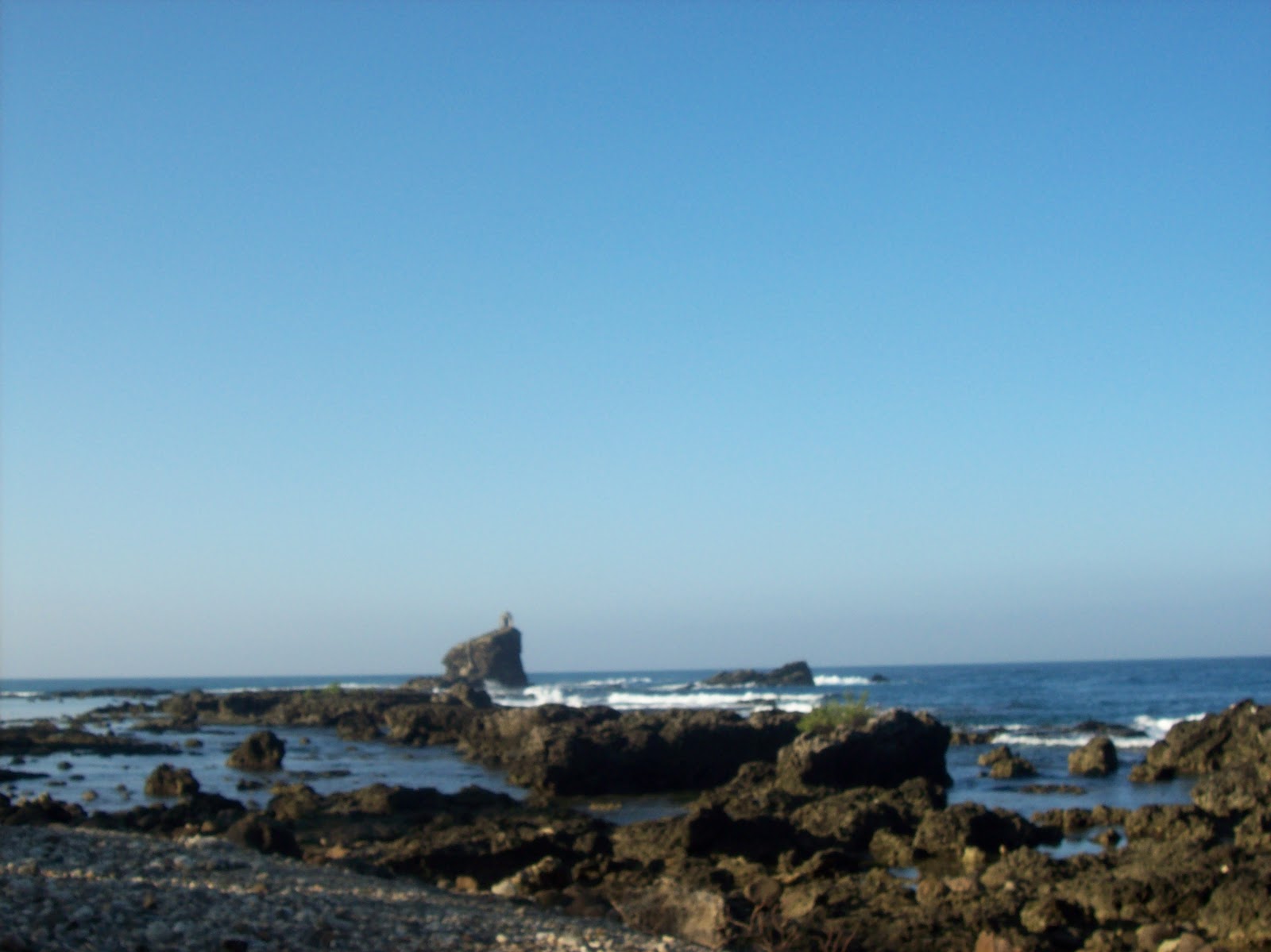
Several steps away from the rocky shoreline of Paraiso is the Immagamang, the local name for the two-storey-high craggy boulder, where a grotto of the Virgin Mary stands solitary on top. This seaside landmark, which got its name from the Ilocano word agamang meaning rice granary or storehouse, is very visible when you are travelling on a curve of the coastal road several kilometers away. 

Although both were first-timers in Ilocos and for this kind of trek, my friends willingly braved the craggy shorelines with me.


There was a part of water which we have to cross to get there. We took off our sandals and folded our pants higher. It was high tide, and the swells were big, while some parts were very slippery. We were fortunate that a relative who also drive us to the place was kind enough to guide us until we reach the wide flat area just below the rock. We lingered for a moment to catch a glimpse around the enticing landscape, that calm and shimmering blue ocean surrounding us, with the verdant coastal hills and mountain ranges providing a picturesque backdrop on the other side, everywhere illumined by the silvery glow of the morning sun. My friends heaved a sigh of relief as they looked back on that part of the shore where we have started.

I took the lead in climbing the rock using the man-made steps on its side (this was not yet made when I was young, so back then only the brave and able would dare to climb the rock with bare hands).

There’s always something about the rock that simply tugs at my heart. As I gaze at the pristine water of the South China Sea at its foot with its intermittent swells breaking at the craggy shores, I can feel the warmth, love, and tranquility of the surroundings.  And best of all the memories it brings are endearing.

During my college days, I couldn’t help looking at the solitary rock while passing this place on my way to Vigan. Because the place is situated in the northernmost boundary of Narvacan, the rock would serve as a perfect marker that would tell me I am leaving my hometown, and when I went home after a week of study in the kabisera, it would be a welcome mark for my homecoming (our home is in Nanguneg, which is situated at the town’s southernmost boundary). When I was in high school, our rowdy group of all boys would haunt the place as a favorite getaway for the awesome view, for fun and adventure, as we loved to race around the rocky area, and for a dive. 

My late wife’s had also scaled the rock with me during our vacation in Narvacan in 1999. She liked it so much when, after a tortuous trek and a risky climb on the side of the rock, we reached the top and got to see the view.

And when I was on top of the rock this time, it was like feeling in love again. That kind of love that makes you feel lost, and yet you know you’re safe. If only I could stay here alone until sundown, I might find the solace I am looking for after a tragic event in my life. I would like to think of my immediate future and at least feel some sense of peace and consolation.

Even for a brief moment with my classmates on top of the rock, I had at least the feeling, that thrill of being on a familiar spot, and be finally home.  

Three days after that climb, I went back to Manila with my friends. It was really for a brief visit, as my life, work and family have been enmeshed in some other place. But again that particular day of November was a moment of being at home and feeling the real comfort of a seafarer after finding a sturdy shelter from a “storm.” And like just any traveler, it was the solace of a home that I tried to seek and succeeded even for the briefest time.

I feel I’ve been uprooted again from my home, away from my father and the whole family, our close-knit clan, our neighbors, and a newfound love. I thought of another homecoming soon, or I risk wasting my life in loneliness away from home.

Monday, September 1, 2008

A WADE TO REMEMBER

WHEN it rains and the wind is never weary, life, to borrow a line from Longfellow, is cold, and dark and dreary. But to most Metro Manila residents, life is made colder, darker and drearier by the perennial floods.

Last month, when typhoon Karen sideswiped the metropolis when it entered Northern Luzon in a whiplash, I cuddled safely at home in Marilao, Bulacan. And despite the dull and gloom, I had reasons to celebrate, one for getting a reprieve from my midterm exam that day, and two, for being spared from braving the floods in the sinewy streets of the metropolis all because of class and work suspension.

Fortunately, the subdivision where my family lives lies comfortably on an elevated part of a wide span of rolling hills and plateaus in southern part of the town, so we were not at all bothered by floods, unlike people in some areas in the province or in that seemingly cursed coastal or riversided cities in the Metro.

But my personal celebration was dampened by the news that my relatives in Narvacan, my hometown in Ilocos Sur, were severely affected by the typhoon. Vast tracts of ricelands were submerged in the flood, and even residential areas in the poblacion and along the highway that traversed our barangay were not spared. 


Only decades ago, floods were rare occurrences in barangay Nanguneg, even during heavy or prolonged squalls. I mean real big floods when the water level hit the waistline of an adult, or when valuable things had to be hauled off hurriedly to the second floor of our house.

Floods in the barrio are different from those in the city.

Though the degree of peril is higher in our place because our barangay is very near the storm-surge-prone coast of South China Sea, and bounded by two rivers on opposite sides, and that the lost of income due to damaged crops is so real before every farmer’s eyes and he would just look at the damage with the resilience and hopefulness of the Ilocanos.

But unlike the reeking Waterworld of Metro Manila, there are no floating garbage, no abusive tricycle or pedicab drivers or ubiquitous wooden plank-bridge made by street toughies or tambay for a fee, and no cursing at city officials and MMDA personnel for clogged esteros and open manholes.

Against a backdrop of a dull, dark gray of the sky, a flood in the barrio is a vista of unhurried life gone wet and awry—timeless, surreal, a poem, a nostalgia, a sigh. You have to experience it to say it can be anything but dreary!

There’s one memorable flood, some rare episode of nature’s wrath in our barangay then, and it happened on my 17th birthday! I remember that early morning in September when the waters started to rise up to knee level and before eight it rose until it submerged half of the first floor of our house. So immediately we emptied cabinets and moved their contents to the second floor, and so with the pots, plates and silverwares, and the dalikan (earthen stove) and that included the remaining firewood that we can salvage from the dirty kitchen.

Around us were boundless pool and whirlpools of mud and detritus, of drowned chickens, bloated piglets, banana stalks and pairless slippers. The second floor was turned into a jumble of soggy clothes, and school bags and shoes, stools and a bookshelf, and sooted pots and pans, and the dalikan, and stacks of plates and plastic cups, and bottles of bagoong, patis, and salt. A hen and its freezing brood joined us in the fray for space.

The lull before the next barrage of the storm came about during lunchtime. The waters had not subsided even an inch, and sporadic spits of rain in that time span shut us out from any outdoor activities.

We had our lunch on the wooden floor. My mother served a platter of hot rice, a bowl of sardinas which she sauteed with onion and tomato, and a plate of tuyo (dried dilis). And no one ever spoke about a celebration for my special day.

After a hurried meal, Father and Manong Ben played chess on a small bench by the window. Manong Romel and I cozied up in one of the two rooms upstairs and opened up each other’s unfinished pocketbooks. (Manong Milton, our eldest, was in Zamboanga that year.) My three younger sisters scrounged for a space in their noisy play and arguments over their toys and imaginations. Mother wouldn’t like to think our situation in a damp bed; she rather occupied herself with the dalikan, boiling the corn and the kapeng bigas, readying them to warm our stomach throughout the day.

Outside the house, I heard moos and bleats of farm animals wet and sullen under the trees along the elevated shoulder of the highway. Joining the fray were calls from fish vendors and intermittent roars of passing vehicles.

Around four in the afternoon, I saw from the window a chicken keeping itself afloat in the swirling waters in the farm near the house. It must have fallen from its perch in a guyabano tree near our house. It was alive, weak and ready to die any time soon. I jumped into the chilly flood waters, and waded hurriedly to catch the chicken. I brought it upstairs and Mother butchered it for the next meal. And before dusk, we dined together, or rather we feasted, on a steaming sapsapuriket (or dinuguang manok).

While the squall continued to rage outside, the whole family was safe and sound in our damp and muddled place, shrugging the flood off as another chapter of our life in the barrio or as an unusual background for my birthday celebration. And I went to sleep with a hearty burp.